You have set three alarms, double-checked your passport, and scheduled a ride, yet you find yourself standing on a dark curb at 3:55 AM watching a...
Seattle Cab Fare Approximator: Predicting Your 2026 Travel Costs
Imagine sitting in a stationary vehicle on I-5 during a rainy Tuesday morning commute, watching the meter click higher while the Sea-Tac terminal remains miles away. For many travelers moving through the Greater Seattle Area, this financial uncertainty is the most stressful part of the journey. You likely believe that a premium transportation budget should be predictable and transparent. However, relying on a standard cab fare approximator often fails to account for the 22 percent increase in travel time common during our region’s peak congestion periods.
This article provides a clear breakdown of how local taxi meters calculate costs and explains why a fixed-rate car service offers the financial security you need for your 2026 travel planning. We will explore current municipal rate structures, the hidden impact of idling in traffic, and how to secure a professional chauffeur without the volatility of surge pricing or metered surprises. By the end of this guide, you’ll have the confidence to book your next trip across the Eastside with total price certainty.
Key Takeaways
- Discover how a cab fare approximator utilizes local tariffs to estimate costs, while understanding the limitations these tools face when navigating Seattle’s complex 2026 rate structure.
- Gain insight into how unpredictable congestion on the I-5 and I-405 corridors can cause metered fares to escalate far beyond your initial digital estimate.
- Identify the hidden expenses of regional travel, from SR-99 tunnel tolls to Sea-Tac airport surcharges, that are frequently omitted from standard taxi quotes.
- Explore the advantages of transitioning to a fixed-rate Seattle Town Car Service to ensure a seamless, predictable journey regardless of traffic or bridge bottlenecks.
- Understand why a professional chauffeur and a premium fleet provide the punctuality and elite comfort necessary for high-stakes airport transfers and corporate travel.
What is a Cab Fare Approximator and How Does it Work in Seattle?
A cab fare approximator serves as a vital digital companion for anyone moving through the Emerald City. It’s a specialized tool that calculates the projected cost of a taxi trip by weighing the distance between two points against the city’s established rate structures. For travelers landing at Sea-Tac or heading to a meeting in the Central Business District, these tools provide a necessary layer of financial predictability. Understanding how taximeters work is the first step in mastering these estimates, as the physical meter in a cab still relies on a combination of mileage and wait time to produce the final fare.
While technology has advanced significantly by 2026, there remains a distinct gap between a fare estimate and the final metered reality. An estimate is a helpful guide, yet it can’t always account for the 15 percent fluctuation caused by sudden road closures or extreme weather. Seattle’s unique geography, hemmed in by water and hills, means that a single accident on the West Seattle Bridge can ripple through the entire grid, altering the cost of a journey in minutes.
The Role of GPS and AI in Modern Fare Tools
Modern mapping data in 2026 utilizes sophisticated AI to evaluate the shortest versus the fastest routes across the Greater Seattle Area. These systems analyze historical traffic patterns to suggest the most efficient path, whether it’s through the SR-99 tunnel or along the I-5 corridor. A fare approximator is a predictive mathematical model based on static tariffs and dynamic traffic data. Despite these innovations, algorithms frequently struggle to predict the heavy 4:00 PM congestion on I-5. The software might see a clear path, but it doesn’t always feel the pulse of the city’s rush hour or the sudden influx of traffic during a weekend festival at Seattle Center.
Why Approximators are Essential for Travel Budgeting
Corporate travelers rely on these tools for precise expense reporting and to ensure their transport stays within company policy. When planning a personal vacation, an estimate helps you identify the baseline cost of transit before you add 20 percent for gratuities or specific airport surcharges. It allows you to weigh your options effectively. Many savvy professionals choose to compare these taxi baselines with an executive car service. While a standard cab price fluctuates with every red light, a premium car service often provides the peace of mind that comes with fixed, transparent pricing. This eliminates the stress of watching a meter climb while you sit in traffic, ensuring your arrival is as composed as it is punctual.
Breaking Down Seattle Taxi Rates: The 2026 Tariff Structure
The moment you enter a cab in the Greater Seattle Area, the meter begins with a mandatory “drop fee.” As of the 2026 King County rate schedule, this initial charge remains a fixed $2.60. From there, the meter tracks your journey through two distinct metrics: distance and time. When your vehicle maintains a speed above 11 miles per hour, you pay $2.70 per mile. However, Seattle’s notorious gridlock often brings traffic to a crawl. When the vehicle slows below that 11 mph threshold, the meter automatically shifts to a time-based rate of $0.50 per minute. This dual-mode system is why a cab fare approximator might show a wide range for a trip from downtown to the Eastside during peak hours.
Standard surcharges also apply to specific travel groups. If you’re traveling with more than two passengers over the age of 12, expect an additional $0.50 per person. While most standard luggage is included in the base rate, oversized items may incur separate fees depending on the vehicle type. These variables make it difficult to pin down an exact cost without accounting for the specific logistics of your party.
King County and City of Seattle Regulations
The King County Council and the Seattle Department of Finance and Administrative Services (FAS) jointly regulate these tariffs to ensure pricing consistency. They mandate that every standard yellow cab displays a publicly posted rate card in the rear passenger window. You should distinguish these from “For-Hire” vehicles, which operate under different permit structures and may not use a traditional meter. For those arriving at Sea-Tac, understanding Seattle-Tacoma International Airport taxi rates is essential; these often include a $40.00 minimum for trips originating from the airport’s ground transportation center.
Wait Time: The Silent Fare Inflator
Wait time acts as a silent fare inflator that surprises many commuters. If you’re caught behind a Fremont or Ballard drawbridge opening, your final bill can climb by $5.00 to $10.00 despite the lack of mileage. A 15-mile trip from the airport to Northgate can vary by 40% depending on whether you’re traveling at 2:00 PM or during the 5:00 PM rush on I-5. To avoid the unpredictability of a ticking meter during gridlock, many travelers prefer the reliability of a fixed-rate town car, which provides a seamless transition without the stress of fluctuating costs. Using a cab fare approximator helps set expectations, but it cannot account for a sudden 20-minute delay on 4th Avenue.
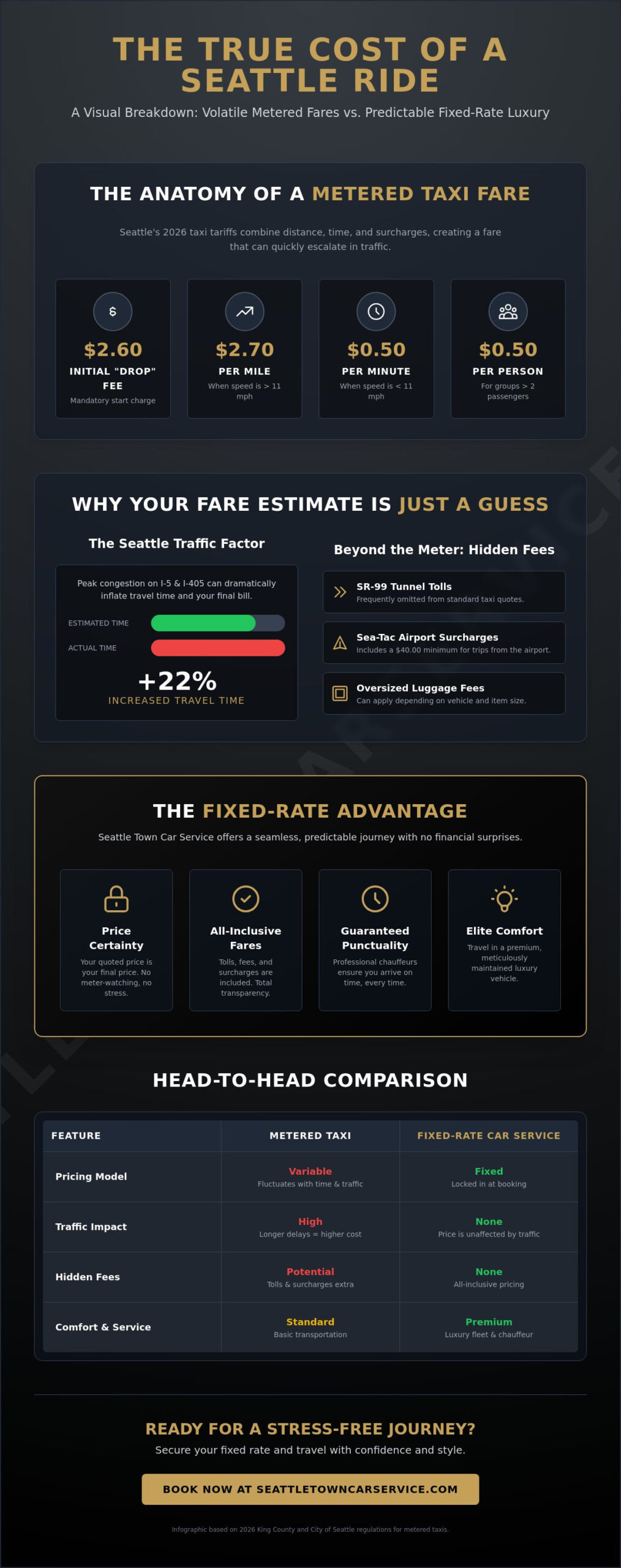
Approximator vs. Reality: The Seattle Traffic Factor
When you plan a trip across the Greater Seattle Area, a digital cab fare approximator offers a convenient starting point. However, these tools often struggle to translate raw mileage into the reality of Pacific Northwest transit. The I-5 and I-405 corridors are notoriously sensitive to volume. A single stall on the Ship Canal Bridge can transform a predictable 20-minute drive into a 50-minute ordeal. Most algorithms calculate cost based on ideal flow, yet Seattle’s infrastructure often dictates otherwise.
Rideshare platforms introduce another layer of uncertainty through surge pricing. While a metered taxi charges based on time and distance, rideshare apps can spike 2x or 3x during a Kraken game or a sudden downpour. Whether you’re navigating the “Mercer Mess” or trying to cross Lake Washington, the gap between an estimate and the final receipt can be substantial. Reliability isn’t just about showing up; it’s about knowing exactly what the journey costs before the wheels turn. For a comprehensive breakdown of how a seattle taxi compares to professional car service options across the region, our 2026 traveler’s reference guide covers fleet standards, pricing structures, and transit efficiency in detail.
Case Study: Sea-Tac to Bellevue Transit Times
- 8:00 PM Arrival: Light traffic on I-405 allows for a 25-minute journey. The meter stays within the lower bound of the estimate.
- 8:00 AM Arrival: Heavy commuter volume and bridge bottlenecks extend the trip to 65 minutes. The meter continues to run during every standstill, often exceeding the initial approximation by 40% or more.
The Volatility of Metered Transportation
Metered rides are inherently reactive. When you’re stuck in traffic near the Convention Center, you’re paying for the privilege of sitting still. Weather events like our signature winter rain or rare snow flurries don’t just slow down the pace; they decrease driver availability, which further inflates costs in real-time. The frustration of watching a meter climb while you’re motionless on Mercer Street is a stressor that high-stakes travelers prefer to avoid.
| Route Scenario | Estimated Range | Potential Peak Cost |
|---|---|---|
| Sea-Tac to Downtown | $50 – $65 | $85+ |
| Bellevue to Sea-Tac | $55 – $70 | $95+ |
Why Fixed-Rate Services Offer Financial Certainty
Choosing a professional town car service eliminates the guesswork inherent in a standard cab fare approximator. We utilize a flat-rate model that remains consistent regardless of bridge closures or highway congestion. Instead of wondering if a $65 meter will balloon into an $85 expense, you receive a guaranteed price at the time of booking. This transparency is a cornerstone of the Seattle airport town car service experience. Our chauffeurs monitor traffic patterns in real-time to find the most efficient routes, ensuring your itinerary stays on track without impacting your wallet. Your focus stays on your business or vacation, while we manage the logistics of the road.
Beyond the Meter: Hidden Fees in Seattle Transportation
When you plan a trip through the Emerald City, the number you see on a standard cab fare approximator rarely tells the whole story. While the meter tracks distance and time, several external factors influence the final cost of your journey. Travelers heading toward the waterfront or through the SR-99 tunnel must account for WSDOT tolling rates. These fees are passed directly to the passenger. If your route takes you to the cruise terminals at Pier 66 or Pier 91, Port of Seattle regulations also apply. These specific pickup and drop-off rules ensure orderly traffic flow, but they often lead to unexpected surcharges that a basic cab fare approximator won’t include in its initial estimate. If you’re still weighing whether you need a car in Seattle at all, understanding these hidden costs is an essential part of making the right transportation decision for your trip.
Tolls and Regional Infrastructure Costs
Crossing the SR-520 bridge involves a variable tolling system that fluctuates based on the time of day. This creates a price gap for Eastside travel that many digital tools fail to capture. In Seattle, tolls are typically added to the metered fare, not included in the base estimate. This means your ride from Bellevue to Downtown could cost significantly more than the baseline prediction during peak morning hours. Our chauffeurs monitor these regional infrastructure costs in real-time to provide the most accurate route efficiency for every guest.
Airport Pickup Logistics and Fees
Arriving at Sea-Tac requires an understanding of the Port of Seattle ground transportation floor fees. Every commercial vehicle picking up passengers must pay a facility fee. This fee is often higher for curbside access compared to the parking garage. For a more detailed breakdown of these logistics, you can view our guide on transportation from seattle airport to downtown. Beyond the airport, passengers often pay a premium for “Cleanliness” and “Safety.” These aren’t just buzzwords; they represent the rigorous maintenance schedules and background checks that define a premium fleet. When you choose a professional service, you’re investing in a 100% sanitized environment and a driver who has passed comprehensive criminal background screenings.
- SR-99 Tunnel Tolls: These vary by time of day and are mandatory pass-through costs for waterfront access.
- Port of Seattle Regulations: Specific staging requirements at Pier 66 and Pier 91 can add time and administrative costs to cruise transfers.
- Facility Fees: Sea-Tac ground transportation fees are set by the airport authority and apply to all commercial pickups.
By choosing a dedicated town car service, you avoid the uncertainty of the meter. We provide transparent, fixed rates that encompass these regional fees, ensuring your journey remains seamless and sophisticated. Whether you’re heading to a corporate meeting or a cruise departure, our commitment to punctual, elite service remains our top priority.
The Professional Choice: Fixed-Rate Seattle Town Car Service
While a cab fare approximator provides a helpful baseline for your 2026 travel budget, it cannot account for the unpredictable volatility of the I-5 corridor or sudden surge pricing during peak seasons. Moving from a rough estimate to a precise schedule requires a shift in service level. Seattle Town Car Service replaces the guesswork of a standard meter with a transparent, fixed-rate model. Our professional chauffeurs offer a level of precision that a standard cab driver simply cannot match. When you book with us, you receive a late-model, luxury vehicle and a dedicated driver who understands the specific nuances of the Greater Seattle Area.
Reliability for Corporate and Executive Travelers
For business leaders, an “approximate” arrival time is a significant liability. A 2023 industry report indicated that 89% of executive travelers prioritize punctuality over any other factor in ground transportation. When you’re preparing for a high-stakes meeting in Bellevue or the downtown core, you need a quiet, clean environment. Our premium fleet serves as a mobile office, allowing you to finalize presentations or take confidential calls without the distractions found in a standard taxi. Fixed rates also simplify your corporate expense reconciliation. Your accounting becomes a one-step task because the price you see during the booking process is exactly what you pay. For a complete overview of what distinguishes basic transport from premium livery, our comprehensive guide to professional car services in Seattle outlines the specific standards and vehicle categories you should expect from a premier chauffeur experience.
Seamless Transfers for Sea-Tac and Cruise Terminals
Navigating the 14-mile stretch from Sea-Tac to Pier 91 often triggers “meter anxiety” as traffic crawls during peak hours. Choosing a fixed-rate service eliminates this stress entirely. We utilize 24/7 flight tracking and advanced dispatch technology to ensure your chauffeur is waiting the moment your plane touches down. Our signature “Meet and Greet” experience ensures you won’t have to hunt for your ride in a crowded terminal or wait in long queues. Whether you’re heading to the Eastside or catching a late-night flight, our team remains available around the clock to provide a seamless transition.
Our commitment to excellence includes:
- Guaranteed Punctuality: We arrive 15 minutes early for every scheduled pickup.
- Luxury Fleet: Choose from executive sedans, SUVs, or stretch limousines.
- Local Expertise: Drivers who know the best routes to bypass Seattle’s 2026 construction zones.
- 24/7 Availability: Professional support for early morning departures and late-night arrivals.
Book your fixed-rate Seattle car service today to secure your 2026 travel plans with total confidence and elite comfort.
Secure Your Seattle Arrival with Predictable Luxury
Navigating the 2026 tariff structure in the Greater Seattle Area requires more than just a basic cab fare approximator. While digital tools provide a baseline estimate for your journey from Sea-Tac, they often fail to account for the volatile traffic patterns of the I-5 corridor or the hidden surcharges found in standard taxi meters. Since 2004, Seattle Town Car Service has eliminated this uncertainty by providing transparent, fixed-rate alternatives for discerning travelers. Whether you’re heading to a corporate meeting on the Eastside or returning home after a long flight, your logistics deserve the precision of a professional chauffeur. Our 24/7 dispatch ensures a late-model luxury sedan or SUV is ready when you are, regardless of the hour. By choosing a pre-arranged service, you bypass the stress of a ticking meter and the unpredictability of city congestion. You can experience the certainty of a fixed-rate ride with Seattle Town Car Service and enjoy a seamless transition to your destination. We’re ready to make your next trip through Seattle both sophisticated and entirely stress-free.
Frequently Asked Questions
How accurate are cab fare approximators for Seattle?
A cab fare approximator provides a reliable baseline estimate, but final costs often deviate by 10% to 15% due to real-time variables. While these digital tools calculate distance accurately using GPS data, they often fail to account for the exact duration of traffic signals or construction delays on I-5. For a precise figure, travelers often prefer the transparency of a pre-arranged flat rate that avoids these unpredictable fluctuations.
Does the Seattle taxi meter run while sitting in traffic?
Yes, Seattle taxi meters switch to a time-based rate whenever the vehicle moves slower than 12 miles per hour. This means your fare increases by $0.50 for every 60 seconds spent idling in Mercer Street congestion or waiting at downtown stoplights. When you need to navigate the city during peak hours, a professional town car service ensures your costs remain fixed despite any heavy traffic encountered along the way.
Are tolls included in the taxi fare estimate?
Standard estimates generated by a cab fare approximator typically exclude the cost of local tolls. Passengers are responsible for the $2.30 to $11.55 toll on the SR 520 bridge or the variable rates for the SR 99 tunnel. These fees are added to the final meter reading at the end of your journey through the Greater Seattle Area to ensure the driver’s operational costs are fully covered.
Is it cheaper to take an Uber or a taxi in Seattle?
Data from 2024 price comparisons indicates that taxis are often cheaper during peak surge periods, while rideshares remain competitive during low-demand hours. Taxis maintain a regulated rate of $2.70 per mile, whereas rideshare prices can spike by 200% during a rainy Friday evening in the city. A town car offers a middle ground with consistent, premium pricing that doesn’t fluctuate based on the weather or demand.
What is the average cost from Sea-Tac to downtown Seattle in 2026?
Based on the City of Seattle’s historical 3% annual rate adjustments, the average metered fare from Sea-Tac to downtown is projected to range between $55 and $75 by 2026. This estimate includes the standard flag drop fee and mileage but excludes the 15% to 20% tip expected for professional service. Traffic conditions during the morning commute can easily push these figures toward the higher end of the scale for metered vehicles.
Do Seattle cabs charge extra for luggage or additional passengers?
Seattle municipal codes allow taxis to charge a $0.50 fee for each additional passenger beyond two, though there’s typically no extra cost for standard luggage. Large items that require a van or specialized vehicle may incur different rates depending on the company. Our premium fleet eliminates these minor fees, providing a seamless experience where the focus remains on your comfort rather than the number of suitcases you’re carrying.
Can I get a fixed rate for a taxi in Seattle?
You can obtain a fixed rate for trips originating from the Sea-Tac airport parking garage, where designated flat-rate for-hire vehicles operate. However, standard yellow cabs hailed on the street must use a meter by law. For travelers who require price certainty for corporate events or Eastside commutes, booking a private town car ensures a guaranteed quote that remains unchanged regardless of the specific route taken by your chauffeur.
Why should I choose a town car service over a metered cab?
When you are attending a corporate event or arriving for a business meeting, choosing a town car service provides a level of punctuality and sophistication that a standard cab cannot match. While a taxi focuses on high-volume turnover, a professional chauffeur prioritizes your specific schedule and provides a personalized Meet and Greet service at the terminal. You’ll travel in a late-model premium vehicle, ensuring your arrival is both comfortable and impressive. If you’re still deciding whether you need a car in Seattle for your visit, our insider guide can help you determine the best transportation strategy for your specific itinerary.

Related Posts